


Hello and welcome back to the garden. It’s a flaming June and high time for a garden tour! It’s peak rose season, and the gardens are looking absolutely gooooorrrrrrgeous, even if slightly singed!
We’ve had a worryingly dry spring, one scorching heatwave in the bag, a week of torrential rain (which was fantastic for the garden), but it’s smoking hot again and another heatwave has landed with a bang!
By the time you read this, we here in temperate Britain will have endured one of the hottest June heatwaves on record, with temperatures (officially) pushing 37°C and coupled with the unusual humidity, feeling over 40°C (95–104°F). Frankly, that is disturbing. It’s only June, for crying out loud!
The prospect of more of these heatwaves is quite terrifying. I am not built for heat! Sun-bathing maniacs aside, hardly any of us tender Brits are. Personally, I tend to melt into a grumpy mess and hide myself away like a particularly disgruntled woodlouse.
But I digress. You’re here for the tour, not to listen to me whine about the absurdities of the weather! So grab something cold and refreshing and let’s begin!
Starting Gates
We’re starting at the main gates, broad and sturdy timber gates, yawning and slightly grumbling on their dry hinges. Thankfully, we’re under the cool shade cast by the mighty fir. As we step inside and crunch over the gravel, you can glance left into a little gravel courtyard.
Nipping inside, still blissfully cool and shady, there’s a selection of plants that cope especially well with shade and a little sunshine. It’s an awkward spot, for in midsummer it can be hot and sunny for a spell in the afternoon. However, the Ilex crenata, skimmias, and hellebores (all potted) are seemingly very content.
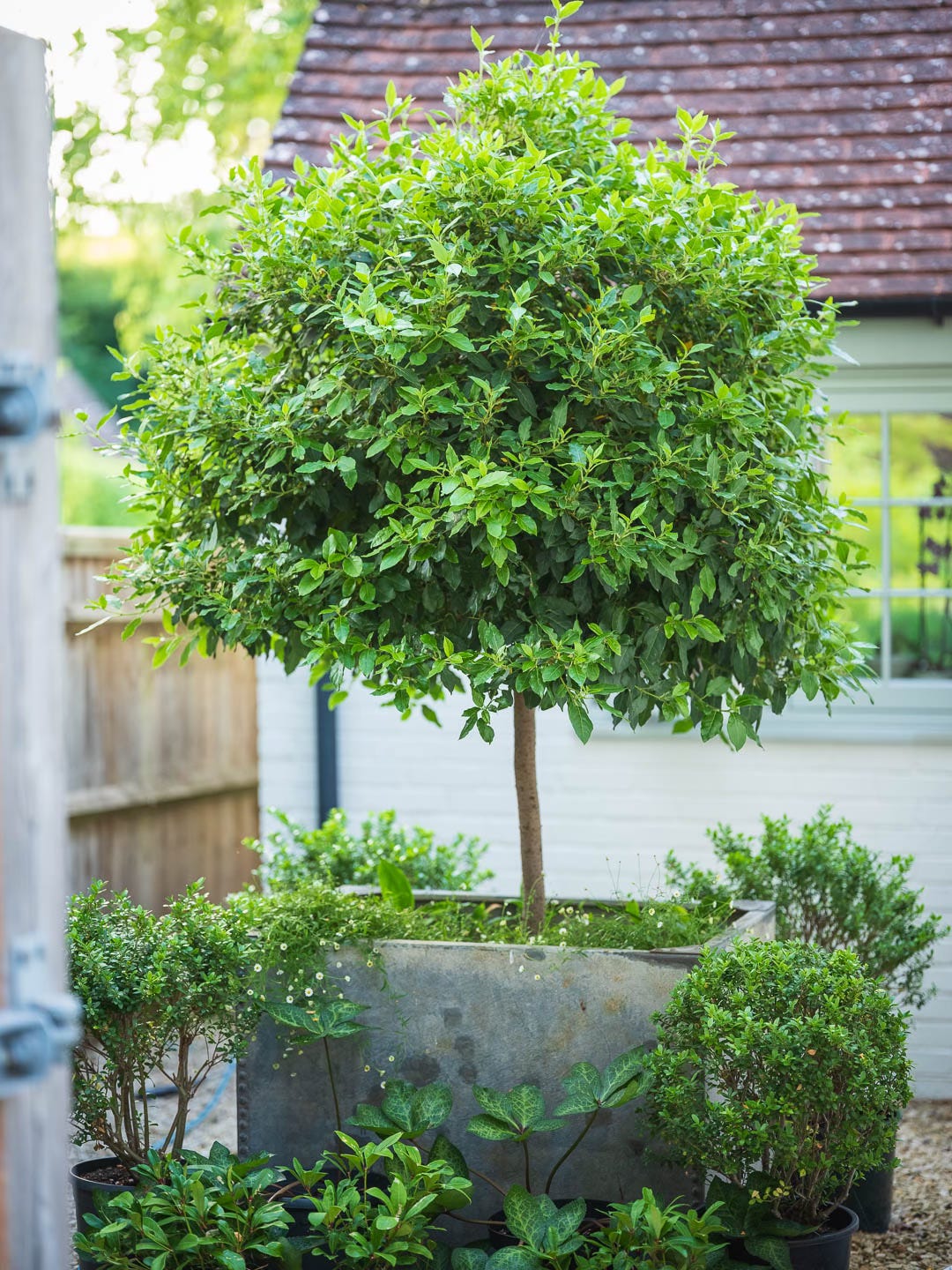
In the middle of the space sits a massive riveted galvanised water tank, planted with a stately Viburnum tinus ‘Eve Price’, trained as a standard like a giant fuzzy lollipop, underplanted with sprawling erigeron, Lily of the Valley, and some opportunistic wild garlic, which I’ll harvest next year for the kitchen. Wild garlic pesto! Yum!
Stepping back into the searing hot driveway, with sunlight bouncing off the dazzling white cottage walls and pale Cotswold gravel, it’s an oven! Sunglasses on! Or a welder’s mask!
Just as you come along the front of the old cottage, there is a handsome A Place in the Garden zinc planter housing a particularly happy olive, underplanted with more erigeron, a running theme. Either side stand a pair of Eucalyptus gunnii and English lavender.
Courtyard Garden: A Pocket of Calm (with Galvanised Glamour)

You know that feeling when you come home and the front of the house just welcomes you? That’s the Courtyard Garden for me. At heart, it’s really just a gravelled extension of the driveway — a small c…
A White Hot Corner
A few steps on and we arrive at the Courtyard Garden, aka the White Garden. (See link above for more) It’s very, very popular on Instagram! It contains over forty containers, the vast majority of which are vintage galvanised buckets, boilers, baths, troughs, tanks, and dolly tubs, with a few feature planters thrown in, including a pair of hefty white marble lotus bowls and a cast-iron French jardinière.
The planting is mostly Mediterranean in character, helping it cope with the ferocious heat, warm roots, and blazing sunshine that arrives from all directions, concentrated like a parabolic lens. There’s a delightfully concentrated floral aroma in this corner, intensified by the heat and lack of breeze.


Planting-wise, there are mounds of English lavender, Salvia nemorosa, Agapanthus, Argyranthemum, all flowering pure white, with Scabiosa ‘Flutter Pure White’ showing just a hint of pink. Grasses provide contrast in form with relaxed and swaying Hakonechloa macra, the very upright Panicum virgatum ‘Heavy Metal’, and dancing Briza media.
There is more variation and contrasting foliage from Pittosporum ‘Silver Queen’, Cedrus atlantica ‘Glauca Pendula’, and Juniperus squamata ‘Blue Star’. In flower right now is a spectacular Clematis ‘Juliane’ smothering an Agriframes Inverted Obelisk, along with Rosa ‘Desdemona’ arching gracefully behind. Recently finished is the white peony ‘Shirley Temple’, which has been absolutely fabulous. There are also two more olives around here (lending much needed height) and a bay in the corner with double-helix stems… one of my favourite things in the garden.
Either side of the front door are two wonderfully huggable buxus cones in Agriframes Classic Zinc Planters. Keeping them company is a pair of stone Guardian lions. The buxus have been resurrected from near death. When they were on the Terrace, I hadn’t realised (until they went brown) that the pots they were in were completely shattered and all the water was simply pouring out of the back!
Cue the Emergency Revival Taskforce.
The bare rootballs were soaked for two days in trugs of water, the roots pruned, soaked again, repotted with fresh compost, fed, heavily watered repeatedly… and they have bounced back magnificently. Such a satisfying feeling! Now it’s regular watering and regular seaweed feed, and they’re flush with vibrant, fluffy new growth. I’m always prowling around them looking for box tree caterpillars!
As we turn towards the Cottage Garden, you can spot a brand-new addition. A fabulous RHS Heritage Zinc Planter from Agriframes (my collaboration partner, if you hadn’t guessed already), perfectly plugging the gap left by the removal of Rosa ‘Generous Gardener’, which never recovered from being brutally butchered by me in an attempt to rejuvenate it. Oh well. You win some, you lose some!
This fine zinc planter has been filled with SylvaGrow Multi-Purpose Compost with added John Innes and planted up with Rosa ‘Iceberg’, that classic pure white climbing rose. She’s now shooting up an Agriframes Half Obelisk. I love this obelisk for climbers, against a wall or fence. It allows the rose to have shape and three dimensions, rather than being tied flat against wires or trellis.
Cottage Cool
Now we can turn round, thankfully leaving the furnace behind, hot-stepping up into the Cottage Garden for cooling greens and dappled shade.
As you climb the steps, passing under the elegant Gothic Arch (where Rosa ‘James Galway’ is making a valiant effort to climb its way to the apex), you brush against a growing number of self-seeders, gently working their way into the cracked and gnarly old railway sleeper steps.
Among these are Geranium nodosum (a prolific self-seeder) and, of course, the ubiquitous Erigeron (Mexican fleabane). Either side are the remnants of the Japanese forest grass (Hakonechloa macra), which is slowly and very sadly dwindling.
I’m not sure whether this is because it’s simply too dry or because of competition from neighbouring plants. Whatever the cause, it’s shrinking every year and it won’t be long before it’s pulled out and replaced with something else. Every cloud… It’s a fairly sunny, incredibly free-draining spot, so perhaps Salvia × jamensis ‘Nachtvlinder’ or even English lavender would be happier here?
Pause for considered thought…


Just at the top of the steps are two huge buxus blobs. I can’t really call them balls, but they do make me happy. I also have a pair of Hydrangea paniculata and more erigeron planted up in pots on the steps. You see, I always like to soften straight, hard edges with pots and plenty of floof!
The front Rose Border is the sunniest border here, with a ground storey of Geranium ‘Rozanne’, Salvia ‘Caradonna’, Alchemilla mollis, and Persicaria superba. Together, they help cover the bare legs of my roses: ‘Desdemona’, ‘Olivia Rose Austin’, ‘Mill on the Floss’, ‘Harlow Carr’, and ‘Emily Brontë’. I would love to have shown you them in their prime, but they peaked early and have all been deadheaded, awaiting the next flush of beautiful blooms.
Popping up here and there, adding a touch of whimsy, are Verbena bonariensis, floaty sanguisorba, and gaura (Oenothera lindheimeri).
The far end, back towards the gates, is also the driest shady corner of the entire garden, sucked dry by the massive fir. It’s been a real problem spot. Every garden has one and this is mine.
I have persevered with tough skimmias (although they’re looking a little leggy), sarcococca, and hellebores, which have almost entirely disappeared now. Lamium, Liriope, and sweet woodruff (Galium odoratum) all made a go of it, but those too have vanished. It’s just so damn dry!
Any desiccated shade recommendations are very welcome!
In the meantime, I’ve cleared the ground, worked in two bags of multi-purpose compost, drenched it thoroughly, and planted Epimedium rubrum. I was reliably informed that this plant is tough as old boots once you get past the first summer. Keeping it company is the bombproof Geranium nodosum ‘Silverwood’. Both should spread and, once established, hopefully survive the dry conditions. We shall see how that goes!
Behind this area was a sorry-looking Magnolia ‘Susan’ and, once again, it was simply too dry and too shady, with the hornbeams massing behind it. The magnolia was removed and replaced with a Japanese maple, one that had been kicking around on the Terrace for years.
I improved the planting hole with ericaceous compost and leafmould and kept it well watered. Now it is absolutely thriving. The leaves are the best I’ve ever seen, a beautiful jade green, and it seems very happy. Glowing, in fact. I’ve planted Brunnera ‘Jack Frost’ and ‘Alexander’s Great’ around the base, with more epimediums thrown in for good measure.
Another new addition is a pair of Agriframes Classic Square Obelisks in sage green. Underneath one of these I’ve planted another rescue, a Clematis macropetala with soft blue nodding blooms. This little clematis normally flowers in spring, but I had to cut it right down when we removed the magnolia it was climbing through, so I’m hoping this will prove to be a happy marriage.
Let’s go further into the Cottage Garden and see what else is going on...
Feel free to take your shoes off and step onto the refreshingly cool, lush new lawn laid just a few weeks ago. This is Rolawn turf and I have tried to look after it. Honestly, gov. It’s been well watered and regularly mown. For me and my entry-level lawn skills, it’s looking pretty good.
I don’t need snooker-table perfection, just a green foil for the rest of the planting.
“I was recently approached by a well-known robot mower brand. They wanted me to create lawn-care content. Barking up the wrong tree there, methinks. I’m well known on Instagram for tearing up my lawn and creating a Flower Garden!”
Woodland Vibes
Ambling around, with fresh cool grass tickling our tootsies, we’re looking at the Hornbeam Border. I’ve slightly lost control of the three hornbeams and the border has grown progressively shadier because the hornbeams are now so wide. It’s now a woodland border filled with shade lovers.
I’d really like to prune them back, but with their size, we’re now firmly into cherry-picker territory. When I bought them, they were cylindrical, practically topiarised. I’d love to bring them back towards that shape, perhaps not quite as extreme, simply to allow a little more light and rain to reach the ground storey planting.
That being said, it is looking extremely lush and verdant.
The late spring and early summer flowering perennials have already finished, most notably hardy geraniums such as G. macrorrhizum and G. sylvaticum. Libertia grandiflora was excellent this year and has only recently finished flowering. A hugely underrated plant for shade. Even dry shade.
Dotted amongst them are the final flower spikes of straw foxgloves, Digitalis lutea. The astrantias are only just getting started and are keeping the Gillenia trifoliata company. Yet to come are the Japanese anemones, looking typically brutish and already preparing to shove their neighbours out of the way.
Just beneath the hornbeams, a river of glistening Brunnera ‘Jack Frost’ and amongst them are epimediums, dicentra (Lamprocapnos spectabilis), and a variety of Dryopteris and Polystichum ferns. After a decent spell of rain, it all looks wonderfully fresh and rather lovely.
Bank Job
Strolling further up the slope, we come to the Bank Border which, as the name rather helpfully suggests, has a large bank behind it.
It’s a pretty tough site because we also have two mature ash trees and a birch tree all sucking the moisture out of the soil. The row of poor Hydrangea ‘Annabelle’ has almost been bonsai’d through lack of root run and moisture. Their flower heads are tennis-ball sized rather than the colossal pillow cushions you really want.
Still, it remains green and there are plenty of buxus balls, Libertia, more ferns, hardy geraniums, pulmonaria, and beautiful stands of Polygonatum (Solomon’s seal).
Thalictrum aquilegiifolium are yet another plant struggling in this extraordinary heat and comparative drought. In contrast, the Baltic parsley, a lovely white umbellifer, is growing exceptionally well. The best I’ve ever seen it.
Perhaps the answer is simpler than we think:
Plant more of what thrives.
Up on the formidably steep bank are the remnants of an old privet hedge. When I moved in, I cut these right down to stumps simply to gain some control over the vegetation. As they regrew, I kept them tightly clipped, first into balls and then combined into clouds.
A cool little feature of the bank. I’m surprisingly pleased with them. An accidental bit of garden design!
Plant Choices
Coming round to the Acer Border, there’s a Viburnum tinus which has also struggled. It sits at the foot of the largest ash tree and simply struggles for moisture. Wrong plant, wrong place.
(I’m not painting a very pretty picture, am I? But at least it’s honest.)
But a little further away, beyond the ash canopy, there’s another wonderful Acer palmatum, along with a whole mass of Astrantia major, fringed-flowered campion (Silene fimbriata), vastly superior Hydrangea ‘Annabelle’, and towering Thalictrum ‘Black Stockings’ forming hefty clumps of robust stems. Towards the front sits another peony, ‘Shirley Temple’, which is absolutely divine.
Again… The answer is simple:
Plant even more of what thrives.
Kitchen Garden Joys
Now we can tip-toe back round to the front border (put our shoes back on) and make our way down the steps towards the Kitchen Garden…Sunnies, sunblock, and parasol at the ready. There’s a brief respite as we crunch our way through the shaded passageway before emerging into the highly productive Kitchen Garden.
The first batch of peas are coming to an end, with yellowing plants and increasingly starchy peas. Thankfully, I have another batch that is still saccharine sweet and intensely green. I’ve been scoffing them like a squirrel in a sack of peanuts. Don’t mind me while I help myself to a few more as we walk.
The first sowings of crisp lettuce have already been enjoyed and cleared, but I’d already sown and planted out the succession crop, which is growing well despite the heat. I am having to water them at least twice a week.
Leafy salad crops detest heat and drought, so never be afraid of watering these crops every day if needed, especially when newly planted.
The fennel bulbs are cropping well, particularly for a spring crop, although I generally find they perform better in autumn. There’s only one left. The rest have been finely chopped and tossed with chunks of orange, then drizzled with a honey and mustard dressing. Yum!
After flowering, the chives have all been cut down and are growing back incredibly quickly. The bees absolutely adored the purple pom-pom flowers, so I’m always happy to let them flower and fade naturally. Garlic chives are just beginning to crop and neatly take over while the regular chives recover.
All around the Kitchen Garden are pots of nasturtiums (some are garishly nasty) alongside a few Helenium ‘Carmen’. I liberated these from the Flower Garden because I really didn’t like the bold yellow there. Around here they can be as yellow as they please!
I’m already enjoying my first proper foray into fruit growing, with a few raspberry canes. The first plump little raspberry has already been duly munched and savoured.
The last of the spring-sown red beetroot are finishing and, in between them, I’ve planted courgettes, sweetcorn, and French beans, all of which will happily cover the space as the beetroot are harvested. This interplanting overlap buys you weeks of extra growing time - essential at 51°North.
The second early Charlotte potatoes should be ready to harvest soon. Butter and apple mint on standby! Gosh, I do love fresh spuds swimming in butter.
Further along are Rose de Roscoff onions (also known as Keravel). A tender, sweet pink onion that is gentle enough for salads, yet also makes the finest onion gravy or onion soup imaginable. Raymond Blanc’s favourite, and who am I to argue with Chef Extraordinaire Raymondo?!
Again, more interplanting here. As the onions will be cropping soon, I’ve tucked lettuce, basil, and more French beans between them.
Tomatoes occupy two more beds and are already over a metre high, with green fruit on their lower trusses. Elsewhere, cucumber ‘Mini Munch’ are tiny but swelling fast, tender orange and purple carrots are ready for pulling, and more sweet beetroot are cropping, ready for roasting or thinly slicing raw with a splash of balsamic.
Lastly, we come to the dahlia bed, which is romping away. We’ve already cut the first flowers. Here I’ve simply knocked in four tree stakes and suspended pea netting between them to support the flower stems. Occasionally you just have to tuck a wandering stem back inside, but the dahlias are looking fabulously healthy and covered in buds.
I did lose one to leaf gall, but swiftly replaced it with Cosmos ‘Pink Cupcakes’.


The Extras
Apart from the massive scorch mark from the earlier out-of-control bonfire (see previous post), there are only a couple more points of interest.
I have just two planters here. One is a VegTrug filled with very gritty soil for rosemary and thyme. The other contains strawberries, and I’m hoping I’ll be able to eat them before the bank voles do. They’ve already set-up their lookout point and mapping the terrain, the cunning blighters.
Either side of the bench sit two dolly tubs containing the rejuvenated bay trees. These originally stood either side of the front door (if you remember those, well done, gold star!) and were heavily infested with scale. They were in a shocking state and looking absolutely dreadful.
So I took the decision to hard-prune them right back until they were little more than bare twigs. That was roughly a year ago. They put on a flush of growth during late summer and autumn, then seemed to stall completely. Now, after a surge of late spring growth, they are bushy, lush, and green once more, looking absolutely lovely… underplanted with erigeron, of course.
Cutting Garden
In the new Cutting Garden we have a fabulous cushiony hedge of English lavender that is positively teeming with bees. There’s a swathe of fleabane and Nigella. The Nigella self-seeded and has practically buried the iris I planted there. There are also a few dahlias that have popped up of their own accord, tubers I missed when clearing the area in spring before building the raised beds to deepen the soil and improve cropping.
“I’m just marvelling at the sheer number of bees on this lavender. There must be a thousand or more. They are everywhere! Oh! And a marbled white butterfly! Well, I’ve not seen one of those in the garden before.
That’s fantastic!”
In the main bed there are blocks of snapdragons and a row of sweet pea ‘Cupani’, along with a couple of rows of sweetcorn and a spare courgette at the end.
Always a spare courgette!
They all seem to be doing surprisingly well in what was originally spent compost from several years of spring bulb displays, simply mounded up and reused.
A quick word on netting… I’ve tried jute twine netting over and over again. Yes, it has the rustic potager vibe, but honestly, I think it’s rubbish. It stretches, sags, and eventually snaps. This years I’ve tried plastic pea netting, but I’m not a fan of the garish fluorescent green plastic. Next year I’ll replace it with steel reinforcing mesh, which I think will look far better and will certainly last my lifetime.
In the spirit of ‘reuse, recycle’ I’ll offer the plastic netting to the local allotmenteers and village gardening club.
And I’m Cooked!
Gosh, the Kitchen Garden is like a furnace! The heat-loving vegetables and lavender absolutely adore it, but those poor salad crops are just about clinging on. Not to mention the gardener!
In fact, I think we’ll pause our tour here. I’m cooked and the sweat is dripping. I’m sure you’re just as eager to escape into the shade too. I’m dictating all this into my phone and it’s about to melt!
So, join me for an icy drink indoors (I’m going ginger cordial) and we’ll pick up the tour again soon enough. Next time, we’ll explore the tranquility of the Terrace Garden, the sublime Shady Table, and dive head first into the floriferous Flower Garden! Until then…
Your fellow flower fanatic,
Elliott 💚
Read more from the TheGardeningKind…
Cornerstones of my kitchen garden No.1

Welcome to a brand new series all about my Kitchen Garden and how to grow gorgeous, tasty, healthy, organic vegetables. It’s easier than you might imagine. Autumn and Spring are perfect times to begi…

The Terrace Garden: Eight Years On

When we moved in, the “back garden” was dark, slimy, and downright treacherous. More slip-and-slide than sanctuary. Now, it’s our sun-soaked, plant-crammed terrace with over 130 pots, two water featu…
I'm sorry you're having to endure this heat. I'm across the pond in Missouri where we get awful heat in July and even awfuller heat in August. I'm starting to make garden plant choices that are more heat and drought tolerant. It's sad that you and all of Europe are having to deal with this awful heat.
I love the tour. Have to sit down later and read it more carefully. Me moving around in the past made me have potted plants parked at my grandparents house. I was so struck by you having a garden made of pots. My Notofagus Antarctica is higher than my three floor house now, all while being in pot. My buxus structures are eaten by the 'famous' moth caterpillar. So happy yours are still alive. I had to replace the hedges with Hornbeam. Keep cool, the heatwave is everywhere in Europe.