


Taking Stock
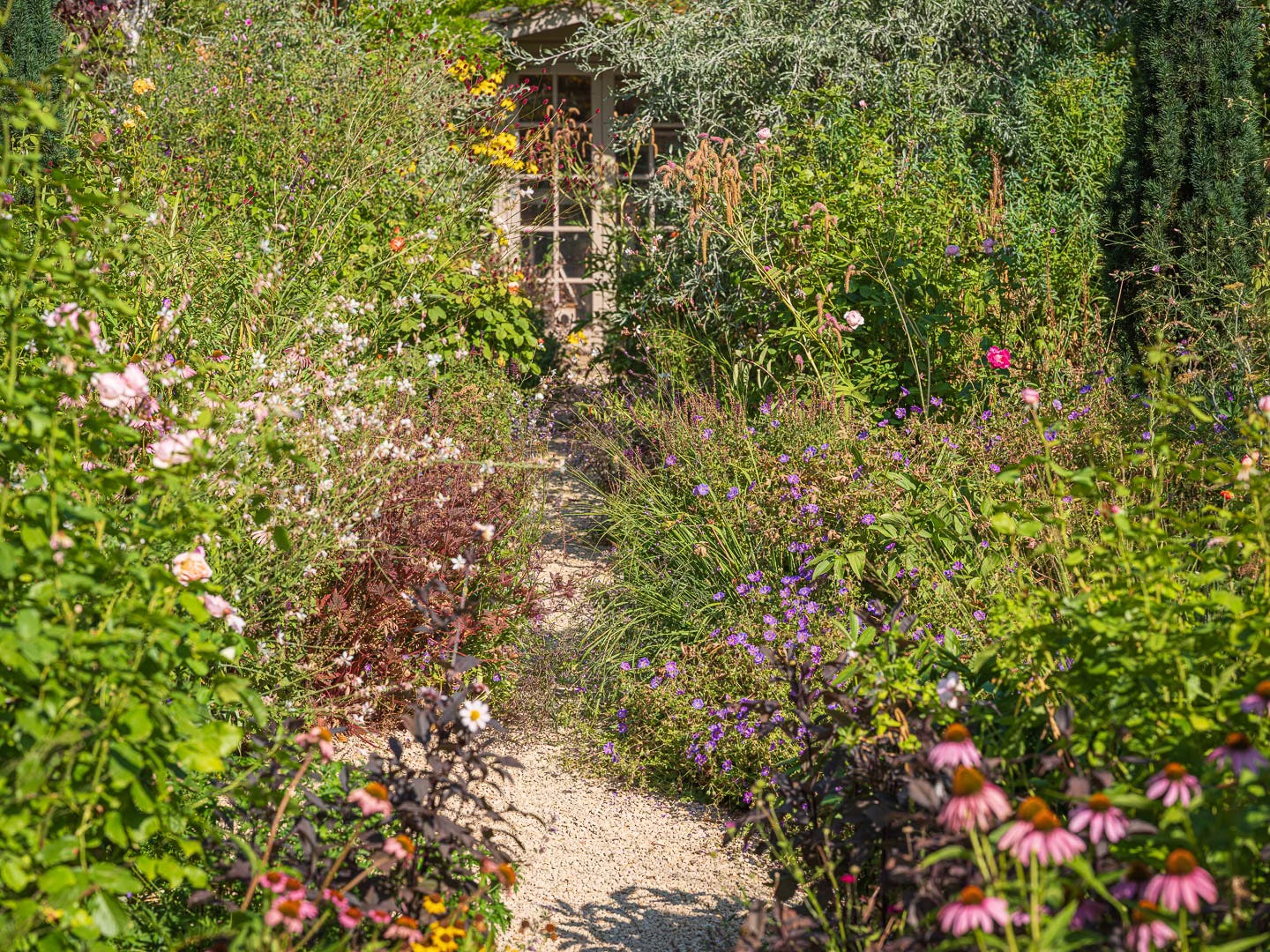
I’ve taken a good, long, hard look at the Flower Garden.
From the top of the Terrace Garden steps, it still appears almost as lush and blousy as ever. A little faded, perhaps, with an unnervingly premature nod to early autumn. Venture down the path, however, peer into those deep borders, and the impact of the drought and successive heatwaves becomes painfully obvious.
There are huge gaps with nothing but parched soil!
It’ll be no great surprise to hear that the moisture-loving, voluminous Persicaria have been widely decimated, leaving the biggest voids, as plants well over a metre across are wont to do. Those that aren’t simply limp and prostrate are stone dead. Crisp! Delphiniums, monkshood, heleniums, hydrangeas, astrantias and many of the plants I moved in spring have also suffered badly, failing to establish despite diligent watering during those crucial first weeks.
At the time of writing, there’s a hosepipe ban and this no-dig Flower Garden still hasn’t been watered. Maybe, by the time you read this, my resolve will have cracked and I’ll have spot-watered the uber-stressed with a can. The only exemptions to my ‘no watering’ rule have been the new plantings in spring and a few early-flowering herbaceous perennials that were cut down in July.
Yet the ferocious heat and drought haven’t wrought complete devastation.
Far from it.
They’ve revealed the clear winners.
The plants that will tough it out through almost anything.
A little radical acceptance
Gardeners can be an awfully self-critical, self-deprecating bunch, especially us Brits. We have a habit of taking plant fatalities as some sort of personal failing, injustice or insult.
I should have watered more.
I should have been more diligent.
I should have been more… more... more...
Something I’ve recently learned about during sessions with my psychologist is ‘radical acceptance’: accepting reality as it is, without judgement, fighting it, or wishing it were different… There’s something rather useful in that for gardeners.
You cannot spend your life watering.
You cannot control the climate.
You’re not a clairvoyant master gardener.
This has been an extraordinary summer.
Give yourself a break!
There have been casualties here, certainly. I’ve made questionable plant choices for my soil and conditions. But while some plants have collapsed, even desiccated, many are surviving and quite a few are positively thriving.
So rather than mourning what failed, I’m paying much closer attention to what succeeded. Planting more of what thrives, not just survives.
The garden doesn’t require reinvention. It simply needs refinement.
I want to avoid knee-jerk changes. I’m certainly not ready to abandon traditional planting wholesale in favour of prairie planting, crushed concrete gravel gardens and succulents. But I do think our idea of the classic English garden will have to evolve.
Some of those old border stalwarts simply aren’t the right plants for today’s conditions. Not here. Not anymore. And that’s OK. With a few rare exceptions, gardens have always evolved.
A plan of attack
I could install irrigation lines throughout the Flower Garden and continue battling the elements for the sake of a handful of plants.
But what would be the point?
I’d rather work with the garden (and nature) than against it. Listening to the plants that are happy here and use more of them.
So the moisture lovers will be culled. I’m quite resolute about that. I have neither the time nor the inclination to nurse permanently unhappy plants. Any survivors showing a hint of life will be potted up and passed on to friends and family, or left outside the garden gate for fellow gardeners in the village to rescue.
May they find happier, damper homes.


Instead, I’ll propagate the obvious winners wherever I can and look for other cultivars to trial. Salvias, knautia, verbena, gaura, nepeta, fennel, Althaea cannabina, echinacea, euphorbias, echinops and, of course, roses have emerged from this summer almost entirely unscathed.
Dare I say it, they’ve flourished.
There have been wonderful surprises too. Sanguisorbas, daisy-flowered dahlias, foxgloves and miscanthus, all plants I’d instinctively have classed as moisture lovers, have coped remarkably well. Perhaps that’s because they’re well established. Perhaps they’ve simply found pockets of more moisture-retentive soil.
Either way, I’ll be keeping a beady eye on them.
I’ll be even more discerning when introducing new plants. There will always be room for experimentation, but I think that occasional and irresistible impulse purchase will have to be substituted with a slice of cake instead.
I’m still a gardener, after all!
Further below are my observations from every border in the Flower Garden. If nothing else, they may reassure you that you’re not gardening through this extraordinary summer alone. And if you find them useful, let me know. I’ll happily share the same audit of the dry, shady Cottage Garden.
It’s also well worth looking at the Jack Wallington survey of thirty drought-tolerant plants, based on observations from gardeners across the UK.


A little bit about the Flower Garden
For those new to The Gardening Kind, my garden sits at roughly 51° north and is broadly equivalent to USDA Zone 8b Maritime. The no-dig Flower Garden occupies a gently sloping site, sheltered to the north and east but open to the west. The house sits to the south.
The soil consists of around 15–30cm (6–12in) of reasonably good topsoil that varies from silty, to sandy, to stony. In places there’s an abrupt change, probably the legacy of old buildings, paths and previous landscaping. Beneath that lies a dense, strongly alkaline, chalk-like clay called Alkali. The pH is almost off the chart.
Why does this matter?
Because the soil type and no-dig change the equation somewhat. Especially if you’re looking for plant suggestions.
The soil here isn’t disturbed, so its structure remains intact. The borders receive nothing more than an annual organic mulch in winter or early spring. No fertiliser. In that undisturbed soil, plant roots can exploit established fungal networks, forming symbiotic relationships and accessing moisture and nutrients over a much wider area than they otherwise could.
In theory, that makes plants more resilient.
The topsoil is relatively well drained, favouring Mediterranean-style plants with broad, fibrous root systems that spread laterally in search of moisture. The clay beneath, meanwhile, seems to favour deep-rooted or tap-rooted plants such as roses, echinops and gaura. Their tough, woody or fleshy roots dive into the subsoil, tapping reserves of moisture long after the surface has dried.
And because the garden slopes, there’s never any waterlogging, even with that clay substrate.
All of which means there is moisture here.
Just not for every plant.
Loss and the emotional attachment
In one sense, I’m very fortunate.
I have a relatively large garden containing hundreds of plants. My only real sentimental attachments are reserved for the Japanese maples, the roses and the evergreen topiary. Everything else is, if I’m honest, part of the supporting cast. I’m entirely pragmatic about whether it stays or goes.
For gardeners with much smaller plots, however, where every plant has earned its place and become a character in its own right, this summer must have been truly heartbreaking.
If that’s you, you have my sincerest sympathy.
This summer has definitively changed my Flower Garden, but not my love for it. If anything, I understand it even better than I did six months ago.
Gardening has always been an exercise in observation, adaptation and optimism. This year has simply reminded me that the plants which thrive or die are usually trying to tell us something.
The trick is being willing to listen.
The Border Book: August 2026
These are my working notes after the hottest, driest summers I’ve gardened through here or anywhere.
This isn’t a scientific trial. It’s simply one gardener’s observations, made in a six year old no-dig garden with alkaline soil in southern England. Every garden is different, but if your summer has looked anything like mine, perhaps these notes will prove useful.
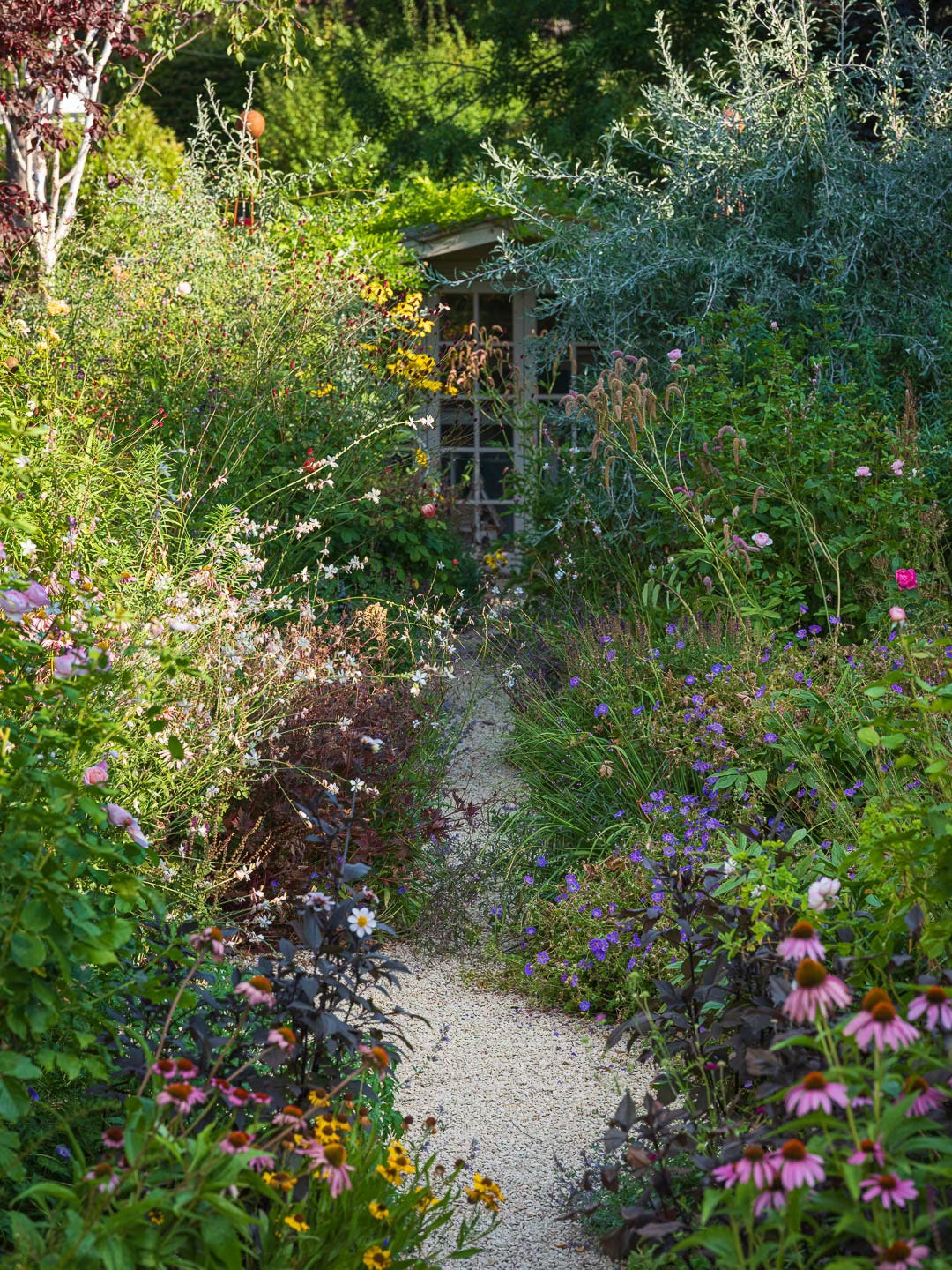
Top Right Border
Casualties
Persicaria - dead.
Salvia ‘Caradonna’ - lost beneath neighbouring plants.
Gillenia - dead.
Delphinium ‘Faust’ - dead.
Rudbeckia laciniata - dead.
Thriving
Roses.
Geranium ‘Rozanne’.
Dahlia ‘Twynings After Eight’.
Molinia ‘Transparent’.
Nepeta ‘Walkers Low’.
Coping
Japanese anemones coping well.
Veronicastrums wilted but should recover.
Giant scabious wilted but should recover.
Autumn jobs
Divide and spread the echinacea further down the path.
Move one large Geranium ‘Rozanne’ to ease pressure on neighbours.
Push the Japanese anemones back into the space vacated by the Persicaria.
Move Calamagrostis ‘Karl Foerster’ further back.
Shift the dahlia beside ‘Eustacia Vye’ further down the border to continue planting rhythm.
Plant more Geranium nodosum and phaeum beneath the roses.
Top Left Border
Casualties
Persicarias and bistorts - dead.
Hesperis - dead.
Japanese anemones in the Constance corner - dead.
Helianthus and crocosmia beside the lilac - dead.
One Molinia never recovered after moving.
Thriving
Roses.
Dahlia ‘Twynings After Eight’.
Foxgloves.
Molinia.
Verbena.
Cirsium.
Persicaria beside the elder.
Fennel.
Salvia ‘Amistad’.
Nepeta ‘Walkers Low’.
Geranium psilostemon.
Geranium ‘Rozanne’.
Elder.
Self-seeded unknown scabious beneath the yew (worth collecting seed).
Coping
Bear’s breeches.
Veronicastrums - wilted.
Recently moved ‘Amistad’ understandably stressed.
Autumn jobs
Divide and spread the echinacea.
Move a Rozanne into the vacant Persicaria space.
Consider moving Rosa ‘Joey’ to the Cutting Garden.
Clear the Constance corner completely.
Decide whether the acer needs irrigation or relocation.
Remove the weak Molinia.
Bottom Right Border
This was by far the hardest hit. Available moisture possibly reduced by the proximity of the mature hedge row outside.
Casualties
Recently moved Perovskia - dead.
Front edge beneath the Edgeworthia - dead.
Crocosmia - dead.
Helianthus - dead.
Delphinium ‘Faust’ - dead.
Hydrangea ‘Annabelle’ x3 - dead.
Monkshood - dead.
Persicaria ‘Fat Domino’ - dead.
Persicaria at the rear of the border. - dead
Most planting beneath the pear tree - dead.
Thriving
Fennel.
Baptisia.
Nepeta ‘Walkers Low’.
Salvia ‘Purple Rain’.
Calamagrostis ‘Karl Foerster’.
Althaea.
Achillea ‘Moonshine’.
Echinops.
Salvias.
Nepeta.
Verbena ‘Bampton’.
Knautia.
Euphorbia ‘Excalibur’.
Established Sanguisorba ‘Lilac Squirrel’.
Established thalictrums.
Miscanthus.
Foxgloves.
Clematis.
Coping
Newly planted ‘Lilac Squirrel’ - wilted.
New ‘Amistad’ - wilted.
Veronicastrums - wilted.
Edgeworthia - wilted.
Bistorta - wilted.
Dogwoods yellowing.
Astrantias - wilted.
Skimmias - wilted.
Eupatorium - wilted.
One of three ‘Red Dragon’ persicarias lost.
Autumn jobs
Thin the Rozanne around the circle.
Review all planting beneath the pear tree.
Replace failed Persicarias with more resilient species.
Reassess the role of moisture-loving perennials in this border.
Bottom Left Border
Interestingly, this border came through the summer remarkably well.
Casualties
Dwarf lilac - dead.
Delphinium ‘Faust’ - dead.
Calamagrostis at the rear - dead.
Everything beneath the winter honeysuckle - dead.
Thriving
Echinops.
Persicaria.
Miscanthus.
Achillea ‘Moonshine’.
Echinacea.
Euphorbia.
Sanguisorba.
Althaea.
Salvia ‘Amistad’.
Nepeta ‘Walkers Low’.
Salvia ‘Caradonna’.
Dahlias.
Geranium ‘Boom Chocolatta’.
Euphorbia cyparissias.
Rudbeckia.
Roses.
Cotinus.
Coping
Hakonechloa around the cherry - wilted.
Salvia ‘Purple Rain’ - wilted.
Helenium - wilted.
Geum ‘Petticoats’ - wilted.
Veronicastrums - wilted.
Phlox - wilted.
Persicaria behind the pear - wilted.
Dogwoods - yellowing
Sarcococca badly affected - wilted.
Autumn jobs
Remove excess Rozanne around the circle.
Consider relocating the eryngium. Too crowded.
Move the nepeta beneath ‘Lady Emma Hamilton’ and ‘Mill on the Floss’ into a sunnier position.
Review whether the winter honeysuckle belongs elsewhere.
Overall observations
Big winners
Salvias
Gaura
Echinops
Echinacea
Achillea
Euphorbias
Knautia
Verbena
Fennel
Roses
Miscanthus
Nepeta
Althaea cannabina
Better than expected
Sanguisorbas
Daisy-flowered dahlias
Foxgloves
Biggest disappointments
Persicaria
Delphiniums
Monkshood
Hydrangeas
Astrantias
Heleniums
Recently transplanted perennials of almost every description
Ideas to explore
Sow wild carrot.
Sow linaria.
Sow poppies.
Trial more Verbena varieties.
Increase Salvia ‘Amistad’, gaura, fennel, Phlomis tuberosa, and Baptisia.
Lift and relocate self-seeded Althaea, verbena, valerian and euphorbia.
Trial lavender and Perovskia again.
Experiment with Artemisia ‘Cola’ (from the Kitchen Garden).
Consider moving the winter honeysuckle to Potting Shed end.
The challenge in my north wales garden is to find plants that have survived the drought in an unprecedented good summer that will also survive the predicted wild wet winter - I’m on a hill but many of my plants sit in running water in the worst conditions. Great article thank you
The notebook is a really useful exercise!