


Phew! I thought we’d wait until the heat passed before continuing our little stroll, but here we are again… as fiercely hot, frying and frazzling as ever! Yes, another heatwave is here. Booooooo! This will be a summer to remember, for sure. I hope you’ve at least had a chance to lay-up somewhere cool and recover since our last steamy walkabout.
Today, we’re venturing back outside and into the furnace. Thankfully, we’ve only the Terrace Garden and Flower Garden left to explore, so we’ll make this a slightly shorter wander. Maybe we’ll be back inside before I start sizzling like a sausage!
Ice packs and electrolytes at the ready… let’s go!
The Terrace Garden

It’s mid-morning and the mercury has already climbed past 25℃ (80℉), though thankfully there’s a comfortable breeze taking the edge off. It rustles through the towering silver birch overhead and sets the Japanese maples below gently quivering. Butterflies are flitting between the plants, hoverflies holding steady overhead. Busy bees are seeking pollen and nectar, revisiting every bloom twice, just to make sure.
If you’re unfamiliar with the terrace, it’s a large paved patio measuring 18m long (60ft), 4m wide (13ft). It levels out the significant downward slope, with a drop of more than a metre (4ft) down into the Flower Garden. It’s a container garden, with over sixty pots and planters, filled with specimen Japanese maples, English shrub roses, clipped buxus, and every remaining gap packed with perennials and annuals. Oh, and a couple of water features too.
Approaching from the Kitchen Garden, tiptoeing past the messy bit (staging tables, hose reel, a mountain of empty pots and so on), the first thing you notice is the perfume. A rich, honeyed, sweet and heady fragrance. Then a mass of deep green glossy leaves smothered in wonderfully fragrant white flowers. That’s the Star Jasmine… Trachelospermum jasminoides. Bit of a mouthful, isn’t it?!
This gorgeous climber has literally doubled in size this year because I finally replanted it into a large galvanised bath. And I mean a proper galvanised bathtub! I used to wash the hounds in it. The jasmine responded almost immediately and is now spreading merrily across the fence on its support wires. Evergreen, flowering from top to bottom, wonderfully scented, and perfectly happy in shade. A great value plant.
Rounding the corner and stepping onto the warm sandstone slabs, the Terrace is looking rather beautiful, if I do say so myself. The stars, without question, are the Japanese maples and the English shrub roses in their vintage dolly tubs. Most of the containers on the Terrace are galvanised metal, some of them absolutely enormous, alongside a handful of sage green or black ceramics.
The Japanese maples grow in Victorian cast-iron boilers mounted on the most ostentatious Catchpole & Rye cast-iron bath feet. Entirely unnecessary... but entirely fabulous too. There are also two square zinc planters from A Place in the Garden and one colossal galvanised water tank.
As you look down the terrace, beneath the north-facing gable, you’ll spot Shady Table and its collection of shade-loving ferns, hostas and gently billowing Japanese forest grass. The terrace naturally divides into two areas. On the left it’s cool, green and shaded. On the right it’s hot, sunny and colourful, with red-leaved acers, pink, coral and apricot roses, salvias, cosmos, dahlias and agapanthus, all interspersed with the white floofy conical flowerheads of Hydrangea paniculata.
As we wander along may notice the dense greenery beneath the Japanese maples. Mostly Japanese forest grass enjoying the dappled shade, but in this first corner, where the shade is deepest, there are various ferns: Matteuccia (ostrich fern), Dryopteris and Polystichum.


Japanese Maples in Full Sun?
Now, a quick word on Japanese maples, Acer palmatum. Practically every gardening book will tell you they dislike full sunshine. That’s true to an extent. But provided their roots never dry out, they’re perfectly happy, particularly in a sheltered position out of the wind. It’s the combination of wind, heat and dry roots that causes that nasty leaf scorch, especially on the more finely cut cultivars such as ‘Dissectum’.
My acers are connected to a simple manual irrigation system, which I switch on for fifteen to twenty minutes every other morning. That’s usually enough to keep the roots contentedly moist. During a heatwave, I’ll occasionally supplement that with a watering can.
Keeping the roots cool is equally important. The capacious thick metal planters warm up surprisingly slowly, while lots of smaller pots are deliberately arranged around the base of each tree to shade the root ball. Every Acer is then mulched with either mini woodchips or cobbles to lock in moisture and keep the compost cooler.
The result? Not a scorched leaf among them. Considering this is the third heatwave in six weeks, I’ll happily take that. But these have been on the terrace for years (some for over a decade), so it’s not simply an experiment and casual opinion.
Moving on… we arrive at the first water feature: a zinc leaf ball from A Place in the Garden. Water gently bubbles over hundreds of individually cut leaves, each one layered and hand-welded onto a spherical frame. It’s quite phenomenal. More sculpture than fountain, really. We actually rearranged part of the terrace planting simply to give it enough space to be properly admired.
I love mixing planting with architectural pieces and water features. Scattered amongst the containers are reclaimed stone finials, columns and balusters. They simply add another layer of interest and a little theatre.
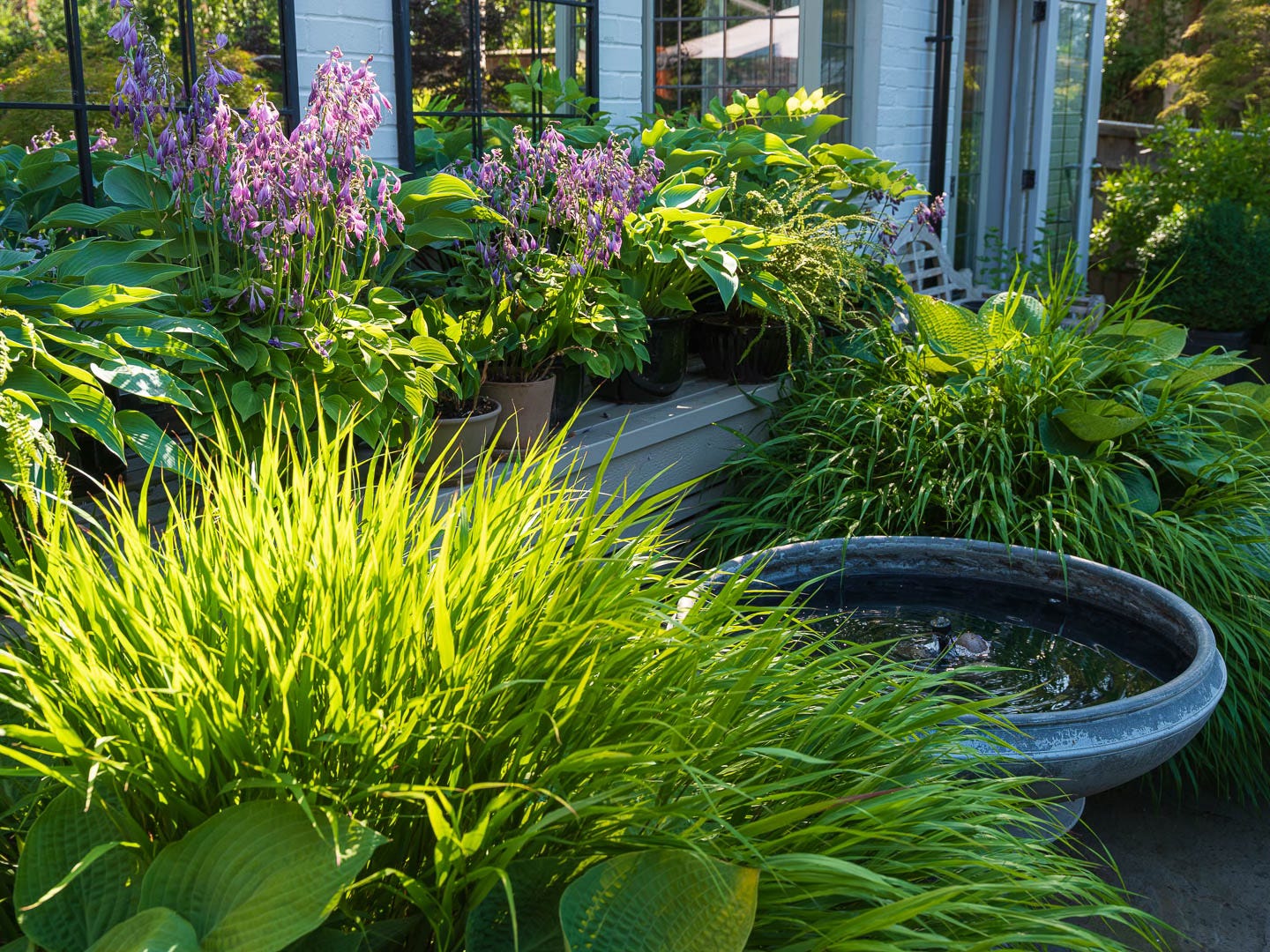
Shady Table

A few steps further brings us to Shady Table, looking absolutely magnificent. I don’t use the word “perfect” lightly, but these hostas are about as close as I’ve ever managed. There are one or two nibbles here and there, and the largest Blue Angels at the front have suffered a touch of discolouration (at the front they’re more exposed to the sun), but otherwise they’re remarkably pristine.
Mixed amongst them are various ferns, epimediums and Solomon’s Seal (Polygonatum), simply to vary the leaf shapes and shades of green. Some of the ferns are now truly magnificent. Two ‘Blue Angels’ are well over a metre across, perhaps closer to a metre and a half.
Amongst them sits the second water feature: a simple lotus bowl with a small fountain producing the gentlest babble… when it isn’t clogged with detritus courtesy of the bathing pigeons! I’m often asked where it came from. The answer is True Fair Trading, although sadly they seem to have ceased trading altogether. Fair or otherwise.


On The Sunny Side
Beside us, basking in the sunshine on either side of the steps, is Rosa ‘Lady Emma Hamilton’, with wonderfully soft peachy blooms and outstanding fragrance. Of every rose I’ve grown, from David Austin or elsewhere, this has proved the most floriferous and the longest flowering. She started blooming in May and, if previous years are anything to go by, will still be flowering well into November.
Keeping Lady Emma company are ‘Boscobel’, ‘Eustacia Vye’, ‘Olivia Rose Austin’ and ‘Young Lycidas’. I had mixed feelings about ‘Young Lycidas’ when it first arrived because it’s rather open and languid in habit. But those blooms! As David Austin describes: blending deep pink, magenta and red – the outer petals tending towards light purple, with an almost silvery quality. They’re beautifully cupped, heavily ruffled and wonderfully fragrant. They don’t simply brown and drop; instead they fade gracefully through softer pinks while hanging on remarkable well. A simple peony support solved those floppy stems perfectly.
Towards the end of the terrace is a newer seating area. The old Lutyens bench has been moved aside and replaced with an Agriframes Pavilion bistro set, nestled beneath an Acer palmatum ‘Seiryu’, surrounded by clipped buxus balls and flowing Hakonechloa macra. It’s a wonderfully green, surprisingly cool little corner to sit with a cup of tea.
Now we can head down the steps into the Flower Garden…
Into The Flower Garden

I don’t have a planting plan to share just yet, but I’ve included a full plant list at the end, with all the plants that have genuinely thrived here.
I do rather wish you could have been here a few weeks ago. My fault entirely for the late invite. The roses were extraordinary. Towering overhead. Arching across the paths. Laden with flowers. I’ll include a photograph simply so we can reminisce together.
Now it’s gently past its first peak, shall we say.
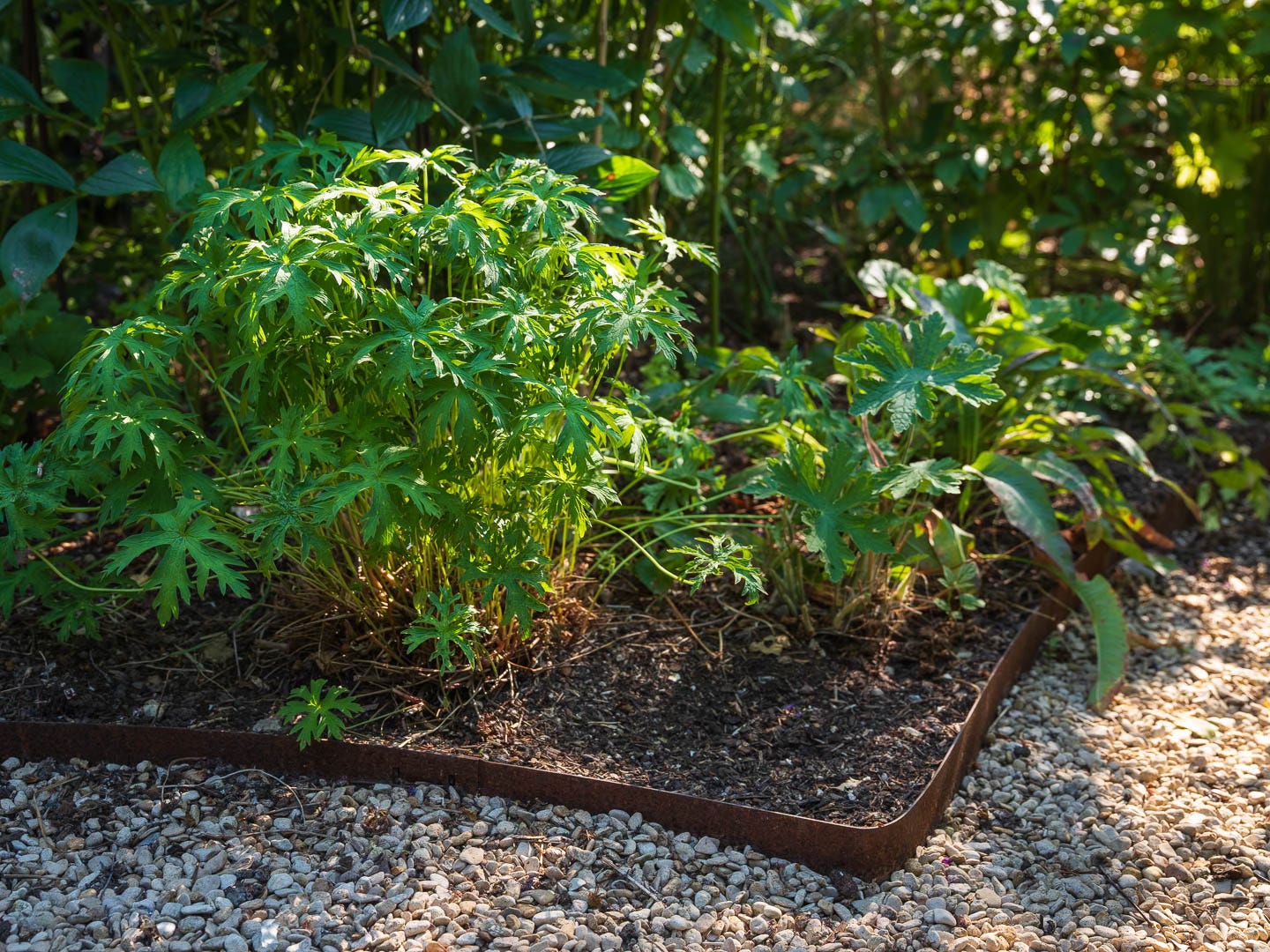
The Summer Shred
The roses have been deadheaded and the annual “summer shred” is complete. Geranium ‘Orion’, Geranium phaeum, Geranium nodosum, Nepeta ‘Walker’s Low’, and Alchemilla mollis have all been cut to the ground. Yet, even after only a week, fresh growth is already appearing and growing strong. Before long they’ll be flowering again.
For the moment, though, the Flower Garden feels quieter. From the terrace steps it still appears (at first glance) wonderfully full, with interest, but not blousy. Varying and repeated forms of plants, with contrasting leaf colours from Dahlia ‘Twynings After Eight’ and ‘Boom Chocolata’, adding their deep purple foliage into the mix.
There’s a definite sense of fading, with spent flower spikes of Salvia ‘Caradonna’ and Salvia ‘Purple Rain’ now a dusty mauve, rather than rich deep purple. They’re in need of a chop. Some I deadhead carefully, taking the stem lower down to new branching stems. Others, I unceremoniously chop down, taking great handfuls at a time. Then tidy up. The staggered approach means I’m never completely without a few spikes of colour.
Once you wander down amongst the borders the temporary gaps become much more obvious. I used to fear the summer shred. What if I killed something? What if nothing grew back? But after several years I’ve learned to trust the process. That’s not to say it’s essential. It’s simply a choice. Leave everything standing and the borders look perfectly respectable, if a little fatigued and flowerless. Cut them back, accept a few nervous weeks of gappy borders, and you’re rewarded with fresh foliage and a second flush of flowers, taking you right to the end of the season.
The birds certainly don’t seem to mind. Within minutes of the chop, they’re hopping across the newly opened ground searching for a tasty morsel or two. Blackbirds making a right old mess, flicking mulch across the path. Bobbin, the robin, seemed particularly happy that I dislodged so many caterpillars, aphids, and little spiders, scoffing a few on the spot, ferrying mouthfuls back to his fluffy fledglings.
As we arrive at the central circle, the narrow side paths reveal themselves, leading towards white benches at either end. I do love a white bench! Climbing and rambling roses, together with vigorous twining wisteria, are steadily smothering the fences. It’s most gratifying to see those fences disappear. My next mini-project is to install arches above both benches, hopefully creating flower-filled arbours by next summer. My collaboration partner, Agriframes, has already sent me two stately Round Arches.
Oh, if you hear little scuttles and chirps amongst the borders, don’t worry. At least two families of fledgling robins and blackbirds are hopping about. Before the summer shred, the garden hummed delightfully with thousands of bees working the nepeta and Geranium ‘Orion’ and it now feels very quiet without their constant drone.


Height In The Border
The planting in the Flower Garden is intentionally tall, for three reasons.
Firstly, the shrub roses. When I first imagined this garden, it was with my partner in mind, so she could enjoy their scent while wandering the paths and easily cut flowers for the house. The roses therefore sit relatively close to the paths, meaning everything behind them needs enough height to remain visible.
Secondly, your first view of the garden is from above, standing at the top of the terrace steps. Too many low mounding plants would have made the whole space feel rather flat and too open. I wanted to descend into the planting and feel completely enveloped by it and for any visitors to feel the same.
Thirdly, I wanted to hide that utilitarian close-board fence. Yuk. I knew the climbers would eventually cloak it, but tall herbaceous perennials and ornamental grasses gave me near-instant height while I waited.
Bringing the height are sanguisorba, Verbena bonariensis, knautia, giant scabious, galega, valeriana, Althaea canabina, fennel, phlox, helianthus, echinops, and miscanthus (grass), to name just a few. I use Sanguisorba ‘Lilac Squirrel’ near the front of the border because those delightfully tactile tassel-like flowers are so fun and silky to the touch. And the fine airy stems do not block the view. I also use Mollinia ‘Transparent’ for the same reason.
From the centre of the garden you can already see the next wave of colour beginning to build. Dahlias, Verbena bonariensis, veronicastrums, heleniums, salvias, Geranium ‘Rozanne’, fresh rose buds aplenty, bronze fennel, sanguisorbas, bistortas, echinaceas and the emerging inflorescence of molinia and miscanthus.
Late summer is never quite as glorious as that first breathtaking flush of early summer, when the borders seem almost wall-to-wall with flowers and the leaves fresh and zesty green. But the softer scattering of colour, together with the graceful movement of the golden and silvery grasses, keeps me perfectly content by the time my own energy is beginning to wane.
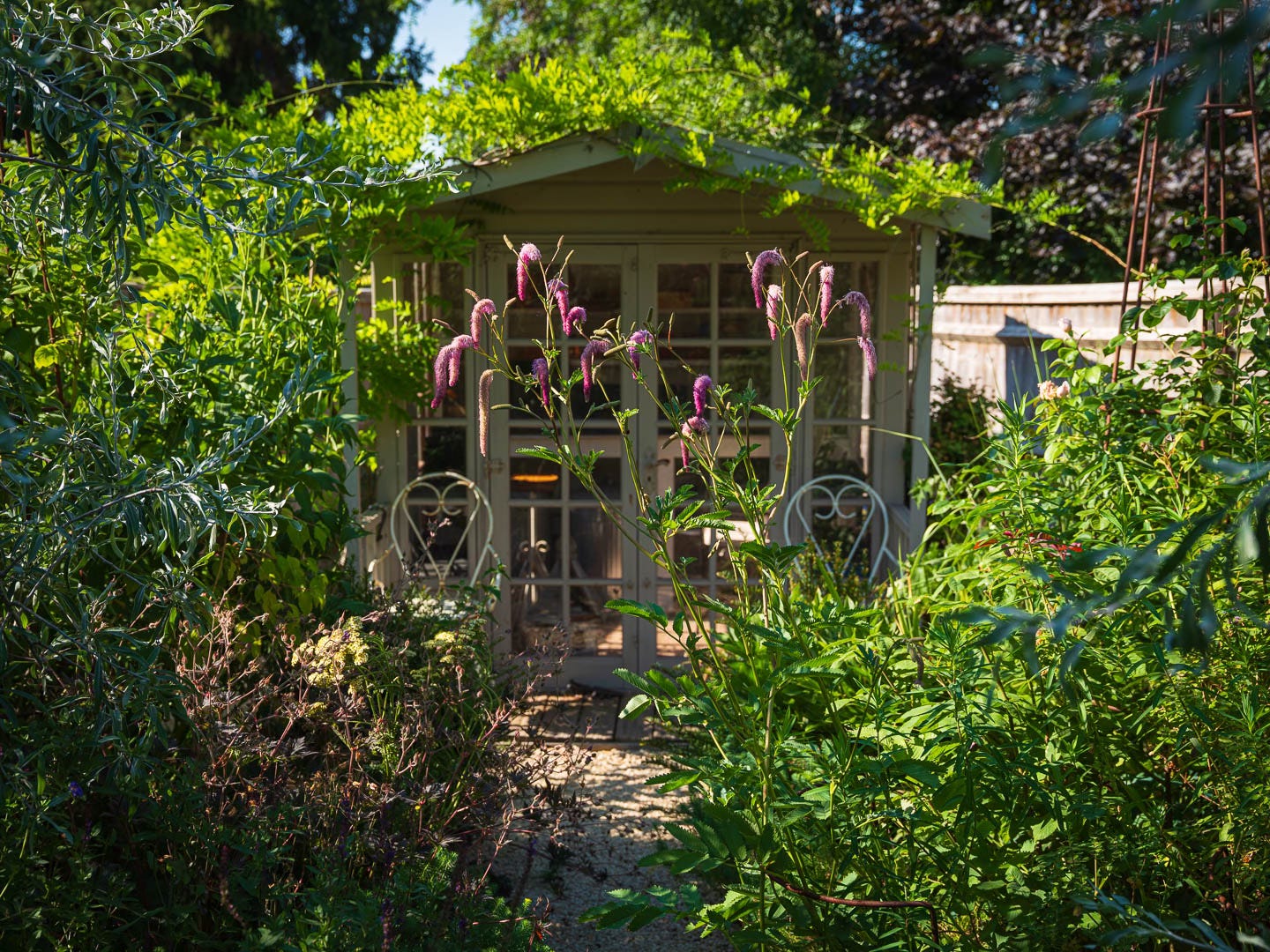
As we near the end of the path, the Potting Shed beckons with cool shade. Or it would if I hadn’t forgotten to open the doors and it’s now an oven. Oh well. I think here we go are separate ways. The gate is just round the corner. My skin is beginning to sizzle, so I’m heading indoors to collapse in front of a fan.
What This Summer Is Teaching Me
Regular deadheading certainly helps extend the display, but even so, this garden is going to be tested by such relentless heat. Three successive heatwaves are asking a great deal of every plant. Especially with the latest forecast to be the longest on record. Crikey.
As a rule, I never water the Flower Garden, apart from new plantings and those I’ve just cut back during the summer shred. Now comes the interesting part…
Do I simply watch to see what continues to thrive? Or do I begin nursing struggling plants through yet another spell of exceptional heat? At some point, one has to draw the line. Some plants you can cut down to give them a breather, but not so with roses. A hosepipe ban feels almost inevitable, and this garden is simply too large (and borders too deep) to maintain it’s verdancy with watering cans alone.
Perhaps this summer will answer the question we asked at the end of Part One.
Stop obsessing over what struggles… and plant more of what thrives.
Until next time my fellow flower fanciers,
Elliott 💚
P.s. Plant lists below.
The Plant List
These plants have suited my no-dig garden, here in Oxfordshire, England (USDA Zone 8b maritime equivalent). It’s an alkaline silty soil, on an Alkali clay substrate. It’s full sun, with a little afternoon shade. It’s very open, sloping, dry, largely faces west, but due to the topography, it lies in permanent shade from November to the end of February. The clay holds moisture from the winter rains, so established plants with deeper roots seem to do especially well.
Please note: Some of these plants may be considered ‘invasive’ in your region or country.
Alchemilla mollis
Alliums
Althea canabina
Bistorta amplexicaulis
Calamagrostis ‘Karl Foerster’
Cephalaria gigantea
Dahlia ‘Twynings After Eight’
Delphiniums
Dicentra eximia
Digitalis
Echinacea purpurea
Echinops ritro
Eupatorium
Euphorbia
Galega
Geraniums: ‘Rozanne’, ‘Orion’, ‘Boom Chocolata’, G. psilostenum, G. phaeum, G. nodosum
Geums: ‘Totally Tangerine’, ‘Pink Petticoats’, ‘Mrs Bradshaw’, ‘Scarlet Tempest’
Helenium ‘Moerheim Beauty’
Helianthus ‘Sheila’s Sunshine’
Japanese anemone
Knautia macedonica
Linaria purpurea
Miscanthus
Molinia ‘Transparent’
Muscari
Narcissus
Nectaroscordum
Nepeta ‘Walkers Low’
Oenothera lindheimeri (Gaura)
Peony lactiflora
Phlomoides tuberosa ‘Amazone’ (Phlomis)
Roses (see below)
Salvia ‘Amistad’, S. ‘Caradonna’, S. ‘Purple Rain’
Sanguisorba ‘Lilac Squirrel’, S. officinalis, S. tenuifolia
Taxus
Thalictrum ‘Black Stockings’
Tulips
Valeriana officinalis
Verbena ‘Bampton’, V. bonariensis, V. hastata
Veronicastrum
Roses
Eustacia Vye
Ancient Mariner
Queen of Sweden
Emily Bronte
Desdemona
Mill on the Floss
Generous Gardener
James Galway
Poet’s Wife
Paul Noel
Albertine
Lady Emma Hamilton
Constance Spry
Rambling Rector
Wollerton Old Hall
New Dawn
Claire Austin
Gertrude Jekyll
Carolyn Knight
Royal Jubilee
Just Joey
Lord Byron
Étoile de Hollande
Lovely tour, thank you. Garden looking at it's best. Decision to water is tricky - like you I leave most of the garden to its own devices but with some shrubs beginning to look sad, I think I will spot water as I don't want to lose them.
What a wonderful tour! Thanks for sharing all these details- as I sit inside with the door open I can hear the blackbirds mulch throwing!